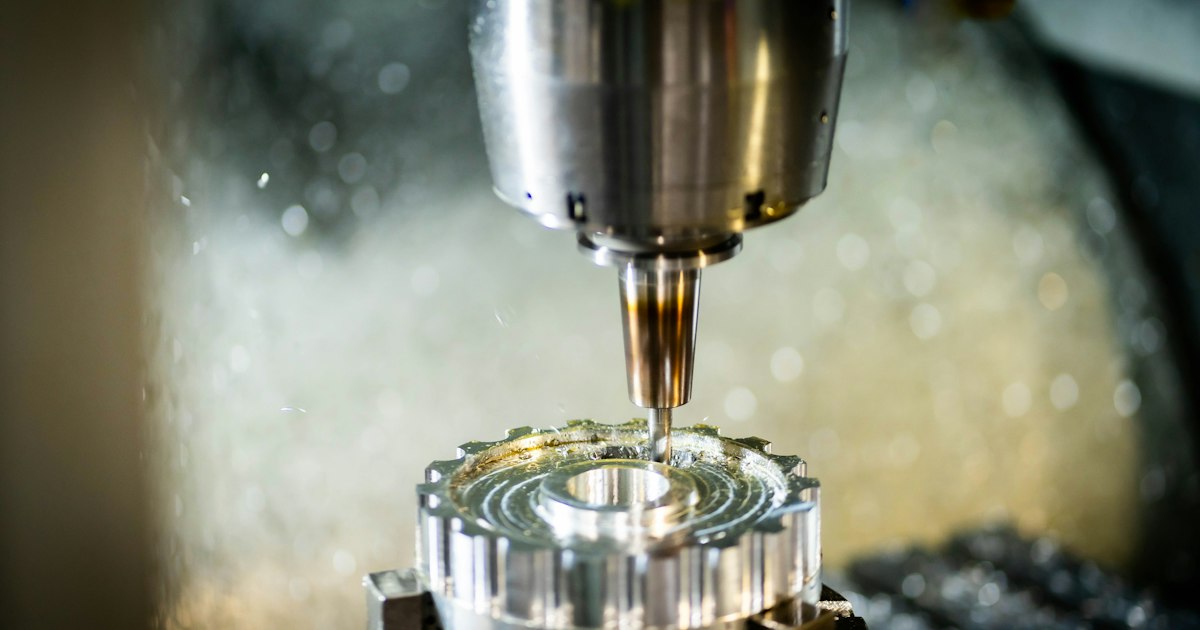
CNC machining in brief
CNC machining cuts parts from bar, plate or castings on computer-controlled mills and lathes. Choose it for metal or plastic parts that need tolerances from about ±0.1 mm down to ±0.013 mm, from one prototype to production lots. Specify a STEP model, a drawing with GD&T, the material and its condition, surface finish, secondary operations, quantities and inspection documents.
Syzygy Industrial Hub (SyzygyHub) connects manufacturing buyers with validated CNC machining suppliers in Canada. The buyer uploads drawings and a request for quotation. Y Brain, the platform's artificial intelligence, routes the request to suppliers whose processes, certifications and location match.
CNC machining tolerances and capabilities
Typical process values. Actual capacity varies by shop and must be confirmed with the supplier.
- Without grinding, CNC milling typically holds ±0.025 mm (±0.001 in) on critical features, and turning, boring or reaming about ±0.013 mm (±0.0005 in), subject to confirmation by the supplier.
- ISO 2768-1 class m allows ±0.2 mm on an untoleranced dimension over 6 mm up to 30 mm, and class f allows ±0.1 mm.
- The usual as-machined surface finish is Ra 3.2 µm (125 µin), and Ra 0.4 µm (16 µin) or finer usually requires grinding, honing or polishing.
- Swiss-type lathes machine bar typically up to about 32 mm (1 1/4 in) in diameter, supported by a guide bushing beside the tool, which suits long, slender parts.
- Aluminum expands about 23.6 µm per metre per °C, roughly twice as much as steel, so a 300 mm aluminum part changes by about 0.007 mm per °C.
Source: CNC Machining in Canada: Processes, Tolerances and What to Specify, a guide from the SyzygyHub library, with the standards cited.
How to get CNC machining quotes
Submit your request for quotation
Upload your drawings and files, then state the material, quantities, tolerances and required date.
Receive targeted quotes
Y Brain routes your request to validated CNC machining suppliers whose processes, certifications and location match.
Choose your supplier
Compare the quotes received on the same scope and start with the supplier that suits you.
What to include in your request for quotation
A complete request lets suppliers price the same scope, without assumptions.
3D model in STEP format (ISO 10303), at the same revision as the drawing.
2D drawing in PDF with tolerances, GD&T (ASME Y14.5, with its edition), datums and the general tolerance note; say which document governs.
Material: alloy, temper or condition, and standard, for example 6061-T6 plate to ASTM B209.
Quantities: prototypes, lot sizes and estimated annual volume.
Critical dimensions, flagged on the drawing.
Surface finish (Ra) and edge condition.
Heat treatment and coating specifications, with masked surfaces.
Inspection documents: FAI report, CMM report, material certificates, certificate of conformance.
Required certifications and controlled goods status.
Delivery date, destination and packaging.
Frequently asked questions about CNC machining
How do I get CNC machining quotes with SyzygyHub?
You upload your drawings and your request for quotation once. Y Brain, the platform's artificial intelligence, routes the request to validated CNC machining suppliers whose processes, certifications and location match. Access to drawings is covered by a non-disclosure agreement. You then compare the quotes received and choose your supplier.
What tolerance can CNC machining hold?
Without grinding, CNC milling typically holds ±0.025 mm (±0.001 in) on critical features, and turning, boring or reaming about ±0.013 mm (±0.0005 in), on rigid parts in stable materials. A reamed or bored hole typically meets ISO 286 grade IT7, for example Ø20 H7 (+0.021/0 mm). Tolerances tighter than roughly ±0.005 mm generally require grinding, honing or lapping. Capability varies by shop and must be confirmed with the supplier.
What is the difference between 3-axis and 5-axis CNC machining?
A 3-axis machine moves the tool in X, Y and Z and reaches one face of the part per setup. A 5-axis machine adds two rotary axes. In positional (3+2) mode the rotary axes lock at an angle so that several faces are machined in one clamping. In simultaneous mode all five axes move during the cut, as impellers, blades and sculpted surfaces require. Fewer setups mean less position error between features.
What files should I send to get a CNC machining quote?
Send a 3D model in STEP format and a 2D drawing in PDF at the same revision. The model gives the geometry for programming; the drawing carries what the model does not: tolerances, GD&T, datums, threads, surface finish, material and finishing specifications. Add the quantities, the inspection documents required and the delivery date. State which document governs if the model and the drawing differ.
What surface finish is standard on CNC machined parts?
The usual as-machined finish is Ra 3.2 µm (125 µin). Ra 1.6 µm (63 µin) needs a finishing pass and Ra 0.8 µm (32 µin) a slow pass with sharp tooling, so both add machining time. Ra 0.4 µm (16 µin) or finer usually requires grinding, honing or polishing. Specify fine finishes only on functional surfaces such as seal faces and bearing seats.
Other processes
Read the full guide · How the platform works · Version française
Page reviewed on October 7, 2026.