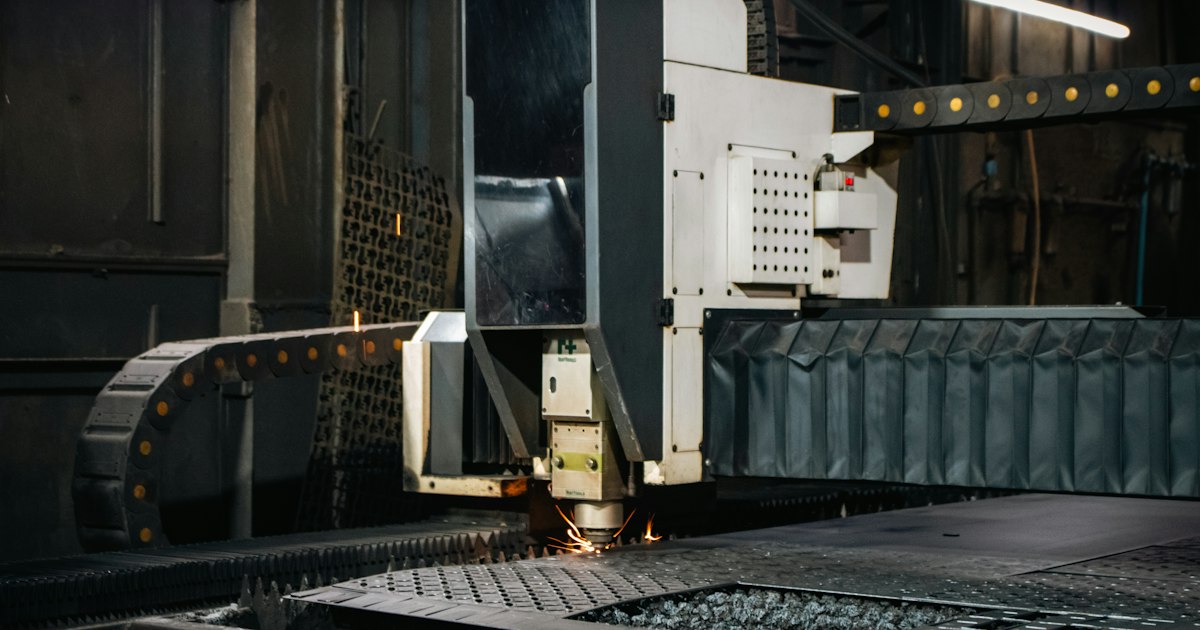
Laser cutting in brief
Laser cutting uses a focused beam and an assist gas to cut flat parts from metal sheet and plate without dedicated tooling. Choose it from prototypes to recurring production runs in carbon steel, stainless steel and aluminum, commonly up to about 25 mm (1 in) depending on laser power. Specify material grade and thickness, tolerances, edge condition (nitrogen or oxygen cut), secondary operations and inspection documents.
Syzygy Industrial Hub (SyzygyHub) connects manufacturing buyers with validated laser cutting suppliers in Canada. The buyer uploads drawings and a request for quotation. Y Brain, the platform's artificial intelligence, routes the request to suppliers whose processes, certifications and location match.
Laser cutting capabilities and tolerances
Typical process values. Actual capacity varies by shop and must be confirmed with the supplier.
- A fiber laser emits at about 1.06 to 1.08 µm and a CO2 laser at 10.6 µm; metals absorb the shorter wavelength better, which is why copper and brass are cut on fiber lasers.
- As an indication, a 6 kW fiber laser makes production-quality cuts up to about 25 mm (1 in) in carbon steel and about 20 mm (3/4 in) in stainless steel and aluminum.
- Typical profile tolerances are ±0.1 to ±0.2 mm (±0.004 to ±0.008 in) on sheet up to about 6 mm (1/4 in) and ±0.2 to ±0.5 mm (±0.008 to ±0.020 in) on thicker plate up to 25 mm (1 in).
- Kerf, the width of material removed by the cut, is typically 0.1 to 0.3 mm in sheet up to 6 mm (1/4 in) and 0.5 mm or more in thick plate.
- Carbon steel cut with oxygen carries an oxide layer that must be removed before painting or powder coating, whereas nitrogen-cut edges are free of oxide.
Source: Laser Cutting in Canada: Capabilities, Tolerances and RFQ Checklist, a guide from the SyzygyHub library, with the standards cited.
How to get laser cutting quotes
Submit your request for quotation
Upload your drawings and files, then state the material, quantities, tolerances and required date.
Receive targeted quotes
Y Brain routes your request to validated laser cutting suppliers whose processes, certifications and location match.
Choose your supplier
Compare the quotes received on the same scope and start with the supplier that suits you.
What to include in your request for quotation
A complete request lets suppliers price the same scope, without assumptions.
Files: DXF or DWG at 1:1 scale, PDF drawing with revision, STEP model for formed parts.
Material: grade and standard, finish, and thickness in millimetres or decimal inches, not gauge alone (16 gauge is about 1.52 mm in carbon steel but 1.29 mm in aluminum).
Quantities: prototypes, lot size, annual volume, delivery schedule.
Tolerances: general tolerance, critical dimensions, holes to be reamed or tapped.
Edge condition: oxide-free edges for welded or coated parts, deburring, cosmetic face, edges to keep free of lead-in marks.
Secondary operations: forming, tapping, hardware, welding, coating, assembly.
Documents: mill test reports, first article inspection report, dimensional report, certificate of conformity.
Packaging, delivery location and required date.
Frequently asked questions about laser cutting
How do I get laser cutting quotes with SyzygyHub?
You upload your drawings and your request for quotation once. Y Brain, the platform's artificial intelligence, routes the request to validated laser cutting suppliers whose processes, certifications and location match. Access to drawings is covered by a non-disclosure agreement. You then compare the quotes received and choose your supplier.
How thick can a laser cut steel, stainless steel and aluminum?
Thickness capacity depends on laser power, material and assist gas. As an indication, a 6 kW fiber laser makes production-quality cuts up to about 25 mm (1 in) in carbon steel and about 20 mm (3/4 in) in stainless steel and aluminum, and a 12 kW machine reaches about 30 mm (1 1/4 in). Copper and brass are limited to roughly 6 to 12 mm (1/4 to 1/2 in). Each supplier should confirm its own limits.
What tolerance can laser cutting hold?
Typical laser cutting tolerances are ±0.1 to ±0.2 mm (±0.004 to ±0.008 in) on sheet up to about 6 mm (1/4 in) and ±0.2 to ±0.5 mm (±0.008 to ±0.020 in) on thicker plate up to 25 mm (1 in). Tolerances widen with thickness and part length, and the cut face has a slight taper. Features that need tighter tolerances, such as bearing bores or dowel holes, are reamed or machined after cutting.
What files does a laser cutting supplier need to quote a part?
A supplier needs a 2D DXF or DWG file at 1:1 scale with closed contours for each flat part, plus a PDF drawing that states material, thickness, tolerances and revision. For parts that are bent after cutting, add a STEP model so the supplier can develop the flat pattern with its own bend allowances. As a rule of thumb, keep hole diameters and slot widths at least equal to the material thickness.
Do laser-cut edges need preparation before welding or powder coating?
It depends on the assist gas. Carbon steel cut with oxygen carries a thin oxide layer that is only loosely bonded to the metal: paint or powder applied over it can flake off, and it can cause porosity in welds, so it is removed by brushing, grinding or blasting. Parts cut with nitrogen have oxide-free edges that can be welded or coated without that step. State the required edge condition in the request for quotation (RFQ).
Other processes
Read the full guide · How the platform works · Version française
Page reviewed on October 7, 2026.