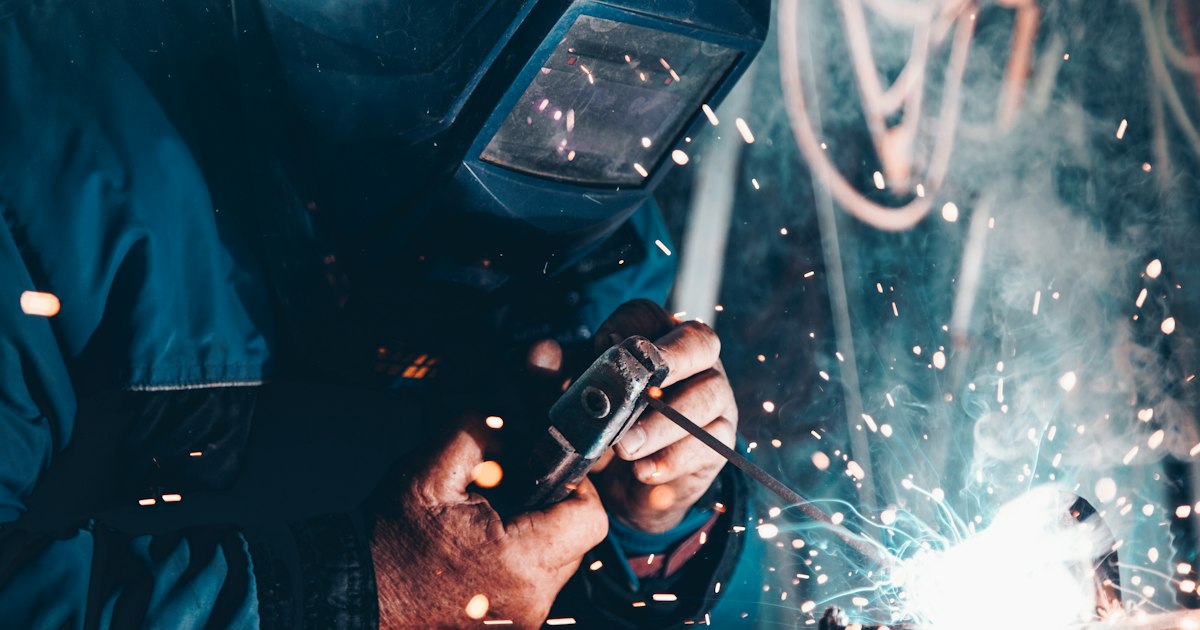
Industrial welding in brief
Industrial welding joins metal parts by fusion, mainly with the GMAW (MIG), GTAW (TIG), FCAW and SMAW arc processes, or by resistance spot welding for sheet. Choose it for frames, structures and enclosures that must carry load or stay sealed. A buyer must specify the materials, the weld symbols with size and length, the governing standard, the company certification required (CSA W47.1 or W47.2) and the inspection.
Syzygy Industrial Hub (SyzygyHub) connects manufacturing buyers with validated welding suppliers in Canada. The buyer uploads drawings and a request for quotation. Y Brain, the platform's artificial intelligence, routes the request to suppliers whose processes, certifications and location match.
Industrial welding processes and certifications
Typical process values. Actual capacity varies by shop and must be confirmed with the supplier.
- CSA W47.1 certifies companies for fusion welding of steel, and its Divisions 1, 2 and 3 describe the company's welding engineer (employed full time, retained part time, or not required), not the materials welded.
- CSA W47.2 is the equivalent company certification for fusion welding of aluminum; a CSA W47.1 certificate does not cover aluminum.
- CSA W59 covers welded construction in carbon and low-alloy steel 3 mm (1/8 in) and thicker; it does not address stainless steel or pressure vessels.
- A CWB welder qualification is generally valid for two years, and only while the welder works for a certified company.
- Magnetic particle testing works only on ferromagnetic steels, so liquid penetrant testing is the usual surface method for aluminum and austenitic stainless steel.
Source: Industrial Welding in Canada: Choosing a Process and a Supplier, a guide from the SyzygyHub library, with the standards cited.
How to get welding quotes
Submit your request for quotation
Upload your drawings and files, then state the material, quantities, tolerances and required date.
Receive targeted quotes
Y Brain routes your request to validated welding suppliers whose processes, certifications and location match.
Choose your supplier
Compare the quotes received on the same scope and start with the supplier that suits you.
What to include in your request for quotation
A complete request lets suppliers price the same scope, without assumptions.
Drawings with their revision, and a 3D model (STEP) if available.
Grade and thickness of each component, and who supplies the material.
Weld symbols (AWS A2.4 or ISO 2553): type, size, length, side.
Governing standard and certification required, for example CSA W59 with CSA W47.1 Division 2.
Inspection: method, welds concerned, extent, acceptance criteria.
Tolerances after welding and features to machine afterwards.
Appearance and post-weld operations: visible faces, welds to grind flush, stress relief, blasting, coating, masked surfaces.
Documents: mill test reports, WPS, welder qualifications, inspection reports, first article inspection report.
Quantities per batch and per year, delivery date, packaging.
Frequently asked questions about industrial welding
How do I get welding quotes with SyzygyHub?
You upload your drawings and your request for quotation once. Y Brain, the platform's artificial intelligence, routes the request to validated welding suppliers whose processes, certifications and location match. Access to drawings is covered by a non-disclosure agreement. You then compare the quotes received and choose your supplier.
What is the difference between MIG and TIG welding?
MIG welding (GMAW) feeds a consumable wire through the gun and deposits metal quickly, which makes it the usual choice for production welds in steel, stainless steel and aluminum from about 1 mm thick. TIG welding (GTAW) uses a non-consumable tungsten electrode, with filler metal added separately. It is slower, but it gives finer heat control and a clean bead without spatter, so it is used for thin material, visible joints and critical welds.
Is CWB certification mandatory for a welding supplier?
Not for all welding. CWB certification is mandatory when a code, regulation or contract requires it. CSA S16, the design standard for steel structures, requires fabricators and erectors to be certified to CSA W47.1 in Division 1 or 2, and CSA S157 sets the same rule for aluminum structures with CSA W47.2. For machine frames or enclosures, the requirement usually comes from the buyer, who can verify a supplier in the CWB directory of certified companies.
What do CWB Division 1, 2 and 3 mean?
The divisions of CSA W47.1 describe a company's welding engineering resources, not the materials or products it welds. A Division 1 company employs a welding engineer full time, a Division 2 company retains one part time, and a Division 3 company is not required to have one. All three need qualified welding supervisors, tested welders and procedures accepted by the Canadian Welding Bureau. Pressure vessels are outside this system and follow CSA B51 and the ASME Boiler and Pressure Vessel Code.
Can any welding shop weld aluminum?
No. Aluminum requires its own procedures and welder qualifications, and a CSA W47.1 certificate does not cover it: structural aluminum calls for a company certified to CSA W47.2. Because of its oxide film and the risk of porosity, aluminum is usually welded with alternating-current GTAW or pulsed GMAW after thorough cleaning. Strength also drops beside the weld: AWS D1.2 requires 165 MPa (24 ksi) from welded 6061-T6 specimens, against 290 MPa (42 ksi) for unwelded T6 sheet and plate.
Other processes
Read the full guide · How the platform works · Version française
Page reviewed on October 7, 2026.